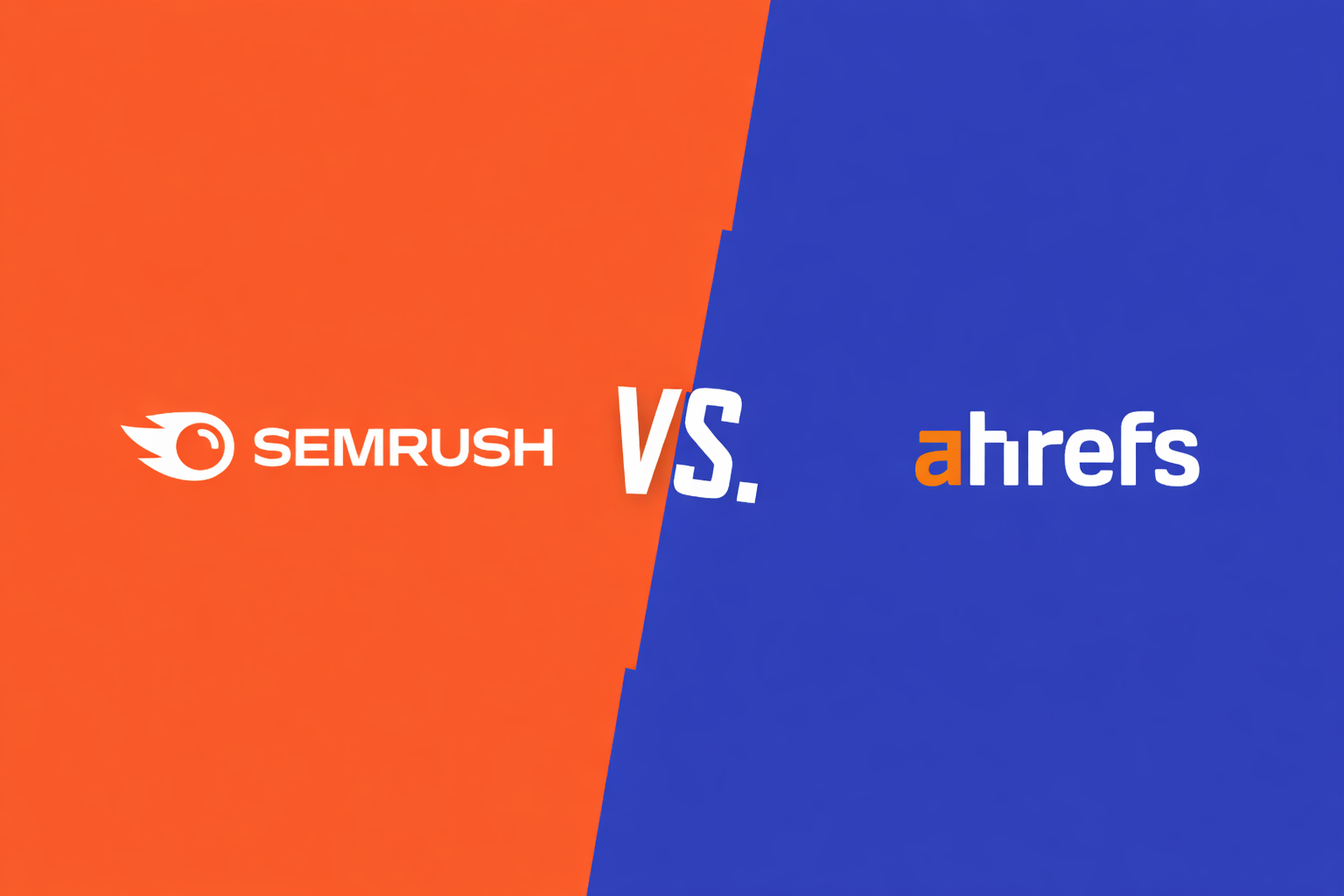
If you work in SEO long enough, you’ll eventually end up using both Semrush and Ahrefs.
They dominate the market for professional SEO software, and for good reason: each platform offers deep keyword research, backlink analysis, site auditing, rank tracking and competitive insights. Yet despite the surface similarities, they feel very different in daily use and they shine in different scenarios.
In this guide, we’ll compare Semrush vs Ahrefs across real-world workflows:
Strategy building, technical audits, content planning, competitor research, reporting, and agency use cases. By the end, you’ll know which tool fits your business model and growth goals.
Table of Contents
Overview of Semrush
SemRush has established itself as a formidable presence in the realm of SEO tools. Launched in 2008, SemRush has grown to offer a comprehensive suite of features that cater to a wide range of digital marketing needs. Whether you are a seasoned SEO professional or a novice just stepping into the world of search engine optimization, SemRush provides a robust platform to help you achieve your goals. The tool is renowned for its extensive database, which is updated regularly to ensure that users have access to the most current data available.
One of the standout features of SemRush is its keyword research capabilities. The platform allows users to discover new keywords, analyze their performance, and track their rankings over time. This is particularly useful for businesses looking to optimize their content for search engines and drive organic traffic to their websites by running an SEO audit. Additionally, SemRush offers a variety of other tools, including site audits, backlink analysis, and competitive research, making it a one-stop-shop for all your SEO needs.
SemRush also excels in its user-friendly interface, which is designed to be intuitive and easy to navigate. This makes it accessible for users of all skill levels, from beginners to advanced SEO practitioners. The platform offers a wealth of resources, including tutorials, webinars, and a vibrant community forum, to help users get the most out of the tool. With its extensive feature set and user-centric design, SemRush has become a go-to choice for many digital marketers.
In practice, Semrush is often used for:
- diagnosing technical SEO problems
- mapping competitive landscapes
- finding keyword gaps
- monitoring SERP features
- and building client-ready reports
It’s powerful, sometimes overwhelming, but clearly designed for marketers managing complex websites and multiple stakeholders.
Overview of Ahrefs
Ahrefs is another heavyweight in the SEO toolkit arena, known for its powerful features and extensive data capabilities. Founded in 2010, Ahrefs has quickly risen to prominence thanks to its focus on backlink analysis and competitive research. The platform is particularly popular among SEO professionals who need in-depth insights into their website’s backlink profile and their competitors’ strategies. Like SemRush, Ahrefs offers a range of tools designed to help users improve their search engine rankings and drive more organic traffic to their websites by using accurate data in combination with SEO audits.
One of the core strengths of Ahrefs is its backlink analysis tool. With one of the largest and most frequently updated backlink databases in the industry, Ahrefs provides users with detailed information about their website’s backlinks, including the quality and relevance of each link. This is invaluable for identifying opportunities for link building and understanding the competitive landscape. In addition to backlink analysis, Ahrefs offers keyword research, site audits, rank tracking, and content exploration tools, making it a comprehensive solution for SEO professionals.
Ahrefs is also known for its user-friendly interface, which is designed to provide a seamless experience for users. The platform offers a range of resources, including tutorials, guides, and a responsive customer support team, to help users navigate its features and get the most out of the tool. With its focus on providing high-quality data and actionable insights, Ahrefs has become a trusted name in the SEO industry.
You’ll most often see Ahrefs used for:
- link-building campaigns
- content planning
- SERP analysis
- competitive SEO research
- and monitoring organic growth over time
I use both tools daily to run SEO audits, uncover growth opportunities, and build data-driven strategies.
Key features comparison
When comparing SemRush and Ahrefs, it becomes clear that both platforms offer a rich array of features, yet each has its own unique strengths. SemRush boasts a broader range of tools, making it a more versatile option for digital marketers who need a comprehensive solution. Its keyword research capabilities are particularly strong, allowing users to discover new keywords, analyze their performance, and track their rankings over time. Additionally, SemRush’s site audit tool provides detailed insights into a website’s health, identifying issues that could impact its search engine rankings and offering recommendations for improvement.
On the other hand, Ahrefs excels in backlink analysis, offering one of the most extensive and frequently updated backlink databases in the industry. This makes it an invaluable tool for SEO professionals who need to understand their website’s backlink profile and identify opportunities for link building. Ahrefs also provides robust competitive research tools, allowing users to gain insights into their competitors’ strategies and identify opportunities for growth. While its keyword research capabilities are strong, they are not as extensive as those offered by SemRush.
On paper, both platforms look similar. In practice, they prioritize different workflows.
Keyword research
Semrush tends to shine at large-scale keyword strategy. Its tools make it easy to group keywords by intent, cluster them into topics, and uncover opportunities across entire markets. It’s especially strong when you’re planning site architecture, pillar pages, or international expansions.
Ahrefs approaches keyword research from a content-first angle. Its “parent topic” logic, click-based metrics, and SERP history make it excellent for deciding whether a topic is actually worth targeting — and how hard it will be to break into the top results.
Most SEOs end up using:
- Semrush for broad planning and gap analysis.
- Ahrefs for validating individual content opportunities.
Backlink analysis
This is where Ahrefs still sets the benchmark.
Its crawler is fast, its link index is enormous, and its historical data makes it ideal for tracking how competitors build authority over time. If link acquisition is central to your strategy — whether through PR, partnerships, or outreach — Ahrefs is extremely hard to beat.
Semrush takes a slightly different angle. While its backlink database is strong, its real advantage lies in risk management: toxic link detection, audit workflows, and disavow-file generation are built directly into the platform.
In short:
- Ahrefs dominates link discovery and analysis.
- Semrush excels at cleanup and governance.
Technical SEO and site audits
Both tools crawl websites deeply and flag technical issues through SEO audits, but they surface insights differently.
Semrush’s Site Audit module is designed for structured remediation. It prioritizes errors, links issues to templates, highlights Core Web Vitals problems, and helps teams coordinate fixes across large sites.
Ahrefs’ crawler feels leaner and faster. It’s ideal for routine monitoring, spotting broken links, duplicate content, redirect chains, and indexing problems without drowning you in dashboards.
For enterprise-scale audits, Semrush often feels more comprehensive. For ongoing health checks, Ahrefs is refreshingly efficient.
Competitive research
Here, Semrush pulls ahead.
Its competitive intelligence tools extend far beyond organic search. You can analyze:
- which pages drive traffic to competitors,
- how much visibility comes from paid ads,
- what keywords dominate an industry,
- and how entire markets shift over time.
Ahrefs focuses more narrowly on SEO competition: who outranks you, who links to rivals, and what content is capturing demand.
If your job involves board-level growth planning or client acquisition decks, Semrush usually provides the bigger picture.
Pricing and plans comparison
Pricing is a crucial factor for many businesses when choosing an SEO tool, and both SemRush and Ahrefs offer a range of plans to suit different budgets and needs. SemRush offers three main pricing tiers: Pro, Guru, and Business. The Pro plan, priced at $139.95 per month, is designed for freelancers, startups, and in-house marketers who need a robust set of tools to manage their SEO efforts. The Guru plan, priced at $249.95 per month, offers additional features such as historical data and extended limits, making it suitable for growing marketing agencies and mid-sized businesses. The Business plan, priced at $499.95 per month, provides advanced features and higher limits, catering to large enterprises and agencies with extensive marketing needs.
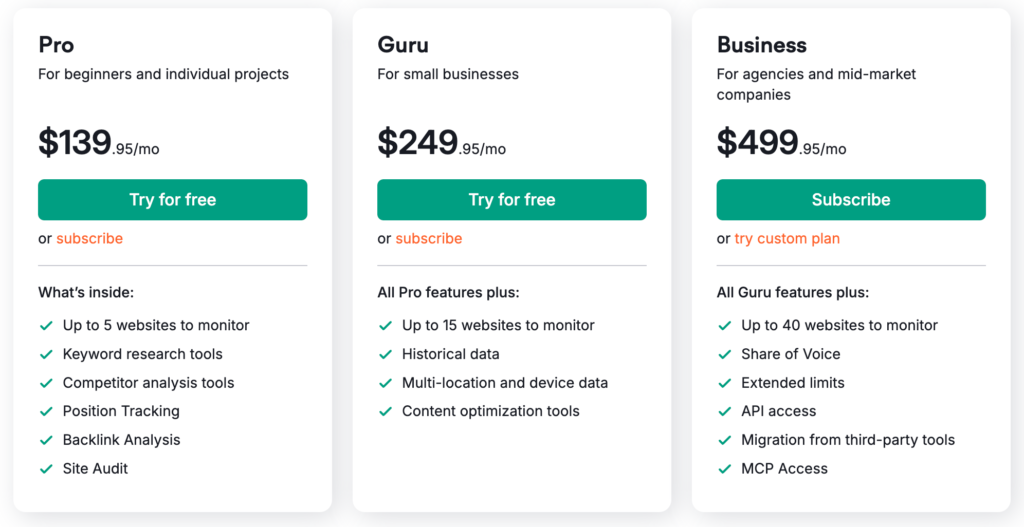
Source: SemRush Pricing Plans
Ahrefs, on the other hand, offers four main pricing tiers: Lite, Standard, Advanced, and Agency. The Lite plan, priced at $129 per month, is designed for small businesses and freelancers who need essential SEO tools. The Standard plan, priced at $249 per month, includes additional features such as content exploration and extended data limits, making it suitable for growing businesses and in-house marketing teams. The Advanced plan, priced at $449 per month, offers even more features and higher limits, catering to larger businesses and marketing agencies. The Enterprise plan, priced at $1499 per month, provides the most extensive set of features and limits, making it ideal for large enterprises and agencies with complex SEO needs.
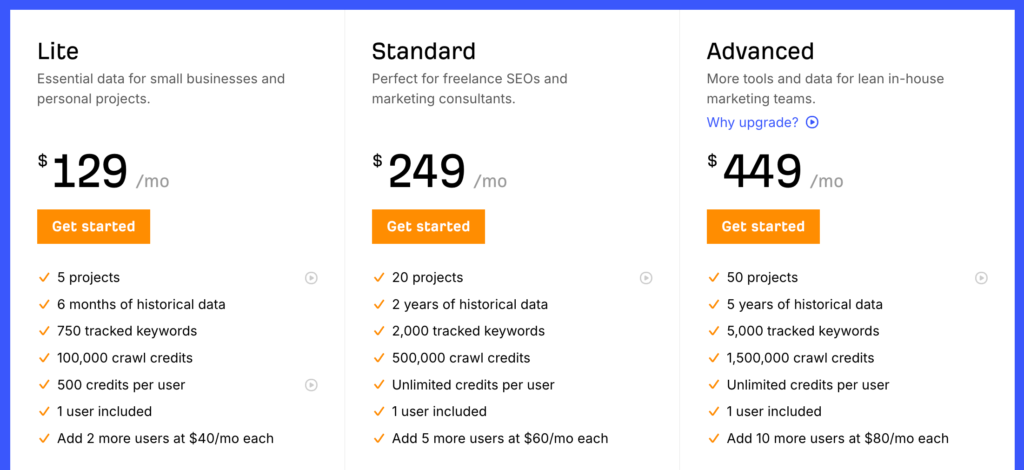
Source: Ahrefs Pricing Plans
While both platforms offer a range of pricing options, it’s important to consider the specific features and limits included in each plan. SemRush’s plans tend to offer a broader range of tools, making them suitable for businesses with diverse marketing needs. Ahrefs’ plans, on the other hand, are more focused on providing high-quality data and insights, particularly in the areas of backlink analysis and competitive research. Ultimately, the best choice will depend on your specific requirements and budget.
User experience and interface
User experience and interface design are critical factors to consider when evaluating an SEO tool, as they can significantly impact your ability to navigate the platform and utilize its features effectively. SemRush has invested heavily in creating a user-friendly interface that is both intuitive and visually appealing. The dashboard is well-organized, with clearly labeled sections and easy access to the various tools and reports. This makes it easy for users of all skill levels to find the information they need and take action based on the insights provided.
Curious to see how well you are doing from an UX perspective? Make sure to run an UX audit.
One of the standout features of SemRush’s interface is its customizable reports. Users can create custom reports that include the specific data and metrics that are most relevant to their needs, making it easy to track progress and share insights with stakeholders. The platform also offers a range of templates and pre-built reports, which can save time and streamline the reporting process. Additionally, SemRush provides a wealth of tutorials and guides to help users get the most out of the tool, along with a responsive customer support team that can assist with any issues that arise.
Ahrefs also offers a user-friendly interface, with a focus on providing a seamless experience for users. The dashboard is clean and well-organized, with easy access to the various tools and reports. One of the key strengths of Ahrefs’ interface is its data visualization capabilities. The platform provides detailed charts and graphs that make it easy to understand complex data and identify trends and opportunities. This can be particularly useful for users who need to analyze large amounts of data and make data-driven decisions.
Ahrefs also offers customizable reports, allowing users to create reports that include the specific data and metrics that are most relevant to their needs. The platform provides a range of templates and pre-built reports, which can save time and streamline the reporting process. Additionally, Ahrefs offers a wealth of resources, including tutorials, guides, and a responsive customer support team, to help users get the most out of the tool. Both SemRush and Ahrefs excel in providing a user-friendly experience, with intuitive interfaces and a range of resources to support users.
Think of it this way:
- Ahrefs feels like a precision instrument.
- Semrush feels like a full control room.
SEO performance metrics: A detailed analysis
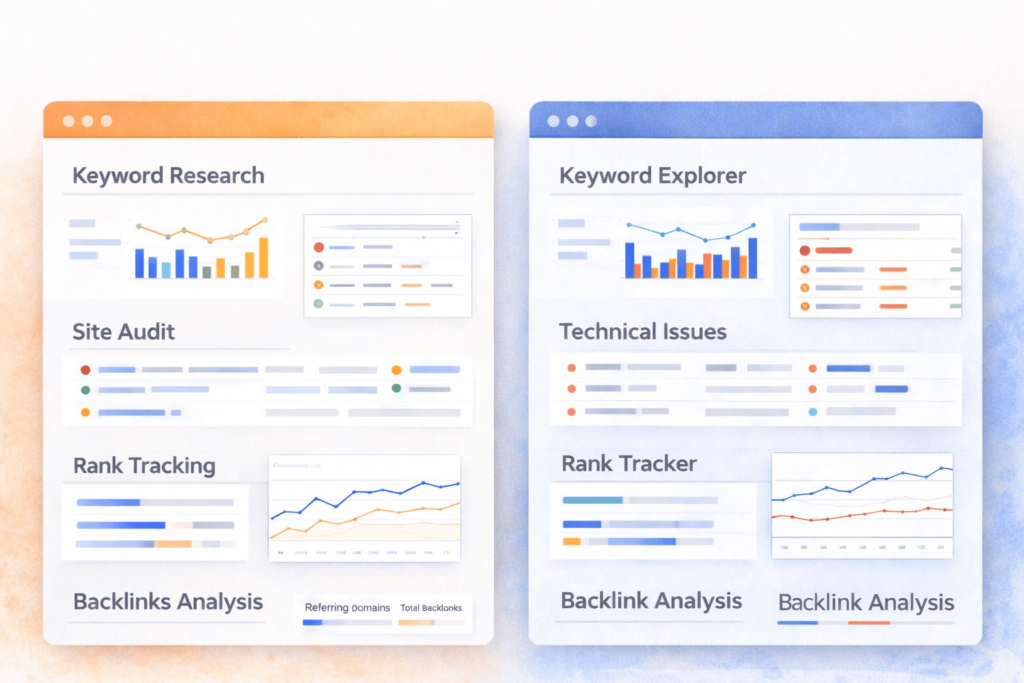
When it comes to SEO performance metrics, both Semrush and Ahrefs provide a wealth of data and insights to help users improve their search engine rankings and drive more organic traffic to their websites. Each platform approaches performance analysis slightly differently, with distinct strengths across keyword research, site audits, backlink analysis, competitive research, and rank tracking.
How Semrush Approaches SEO Performance
Semrush offers a comprehensive suite of tools that cover nearly every aspect of SEO – from keyword research and site audits to backlink analysis and competitive intelligence. One of its key strengths is its ability to surface new keyword opportunities, analyze performance trends, and monitor rankings over time, making it especially useful for content optimization and growth forecasting.
Semrush also excels in technical diagnostics through its Site Audit tool, which evaluates website health and flags issues that could impact search engine rankings. It covers a broad range of factors, including:
- Technical SEO errors and crawlability issues
- On-page SEO problems and missing metadata
- Content quality signals
- Internal linking gaps
- Performance-related warnings
In addition, Semrush’s backlink analysis tool provides detailed information about a website’s link profile, including:
- Link quality and authority
- Anchor text distribution
- Lost and new links
- Referring domains
- Competitive backlink comparisons
These insights are valuable for identifying link-building opportunities and understanding how competitors are acquiring authority.
How Ahrefs measures SEO performance
Ahrefs, on the other hand, is widely known for its powerful backlink analysis capabilities. The platform maintains one of the largest and most frequently updated backlink databases in the industry, giving users deep visibility into off-site SEO signals.
Ahrefs’ backlink data helps uncover:
- New and lost links
- Referring domains
- Anchor text patterns
- Broken backlinks
- Competitor link strategies
Beyond links, Ahrefs also offers robust competitive research tools that allow users to analyze competitors’ strategies and identify growth opportunities. Its keyword research capabilities are strong as well—although they are generally considered slightly less expansive than those offered by Semrush.
Both platforms include rank tracking tools that allow users to monitor keyword positions over time and benchmark performance against competitors.
- Semrush’s rank tracking tool provides detailed insights into keyword rankings, SERP features, and organic traffic trends.
- Ahrefs’ rank tracker delivers similar visibility, with a focus on actionable insights and competitive movement.
When it comes to site audits:
- Semrush’s site audit tool is more comprehensive, producing detailed reports across a wide range of SEO issues that could impact rankings.
- Ahrefs’ site audit tool, while powerful, is more narrowly focused on technical SEO diagnostics.
Who uses which tool?
In practice, clear usage patterns tend to emerge depending on company size, growth stage, and how SEO fits into the wider marketing operation. While both platforms overlap heavily in core capabilities, teams often gravitate toward one based on their workflows and priorities.
Semrush is typically favored by:
- SEO agencies – because of its all-in-one toolset for audits, rank tracking, competitor research, and reporting dashboards that can be reused across multiple clients.
- SaaS growth teams – who rely on keyword gap analysis, paid search data, and content planning features to fuel demand generation.
- Enterprises —-that need scalable site audits, visibility tracking across markets, and cross-channel insights that connect SEO with PPC and digital PR.
- Consultants running audits and CRO roadmaps – thanks to Semrush’s technical diagnostics, SERP feature tracking, and opportunity discovery tools that plug neatly into prioritization frameworks.
Semrush tends to shine in environments where SEO is part of a broader acquisition strategy, sitting alongside paid media, content marketing, and conversion optimization.
Ahrefs tends to dominate among:
- Publishers – who focus heavily on topical authority, editorial planning, and understanding which pages and competitors attract links at scale.
- Affiliate marketers – drawn to Ahrefs’ backlink index and content gap tools when evaluating monetization opportunities.
- Content teams – using its keyword explorer and SERP analysis to reverse-engineer why certain articles rank and how to outperform them.
- Digital PR specialists – who lean on Ahrefs for link prospecting, anchor-text analysis, and monitoring campaign impact after outreach.
Ahrefs is often the weapon of choice for link-driven growth strategies and content-led sites where authority building is the main competitive lever.
Many experienced SEOs eventually subscribe to both, using Semrush for large-scale audits, competitive landscapes, and ongoing monitoring – while relying on Ahrefs for deep backlink research, editorial planning, and authority analysis. At higher maturity levels, the tools stop being substitutes and start becoming complementary parts of the same workflow.
Which SEO tool Is right for you?
Choosing the right SEO tool is a critical decision that can significantly impact your digital marketing efforts. Both SemRush and Ahrefs offer a range of powerful features and capabilities, making them valuable tools for businesses looking to improve their search engine rankings and drive more organic traffic to their websites. SemRush stands out for its comprehensive suite of tools, including robust keyword research capabilities, extensive site audit features, and a user-friendly interface. This makes it a versatile option for businesses with diverse marketing needs and those looking for a one-stop-shop for their SEO efforts.
Common questions about SEO tools
Semrush is generally better for full-stack SEO workflows like site audits, keyword research, PPC analysis, and competitor tracking. Ahrefs often wins for backlink analysis and content research. The best choice depends on whether you prioritise technical SEO and marketing strategy (Semrush) or link building and editorial growth (Ahrefs).
Most SEO agencies lean toward Semrush because it combines audits, reporting, rank tracking, competitor analysis, and paid search data in one platform. Ahrefs is commonly used alongside it for deep backlink research and digital PR campaigns.
Ahrefs is widely respected for having one of the largest and most frequently updated backlink databases in SEO software. Semrush also offers strong backlink tools, but Ahrefs is often preferred for link prospecting, toxic link analysis, and competitor backlink monitoring.
Semrush typically provides broader keyword datasets, search intent labels, SERP features, and paid search insights. Ahrefs delivers excellent keyword difficulty metrics and click-based data, making it popular with content teams and publishers.
At Muntevo, both Semrush and Ahrefs are used strategically depending on the growth objective. Semrush powers technical SEO audits, keyword opportunity analysis, competitor benchmarking, and CRO-driven optimisation roadmaps, while Ahrefs is leveraged for backlink gap analysis, digital PR research, content planning, and authority-building campaigns.
Get an expert-led SEO audit and strategic roadmap from Muntevo. Uncover ranking gaps, backlink opportunities and revenue-driving wins.