Most B2B companies doing SEO don’t have an SEO strategy in place. They have a list of things they’ve tried: some blog posts, a few backlinks, maybe a technical audit that sat in a folder for six months. It showcases activity without a clear direction or strategy.
An SEO strategy is a plan that connects every action, from keyword decisions, content creation, technical fixes, link building to a specific business outcome. For B2B companies and professional service businesses, that outcome is pipeline & revenue.
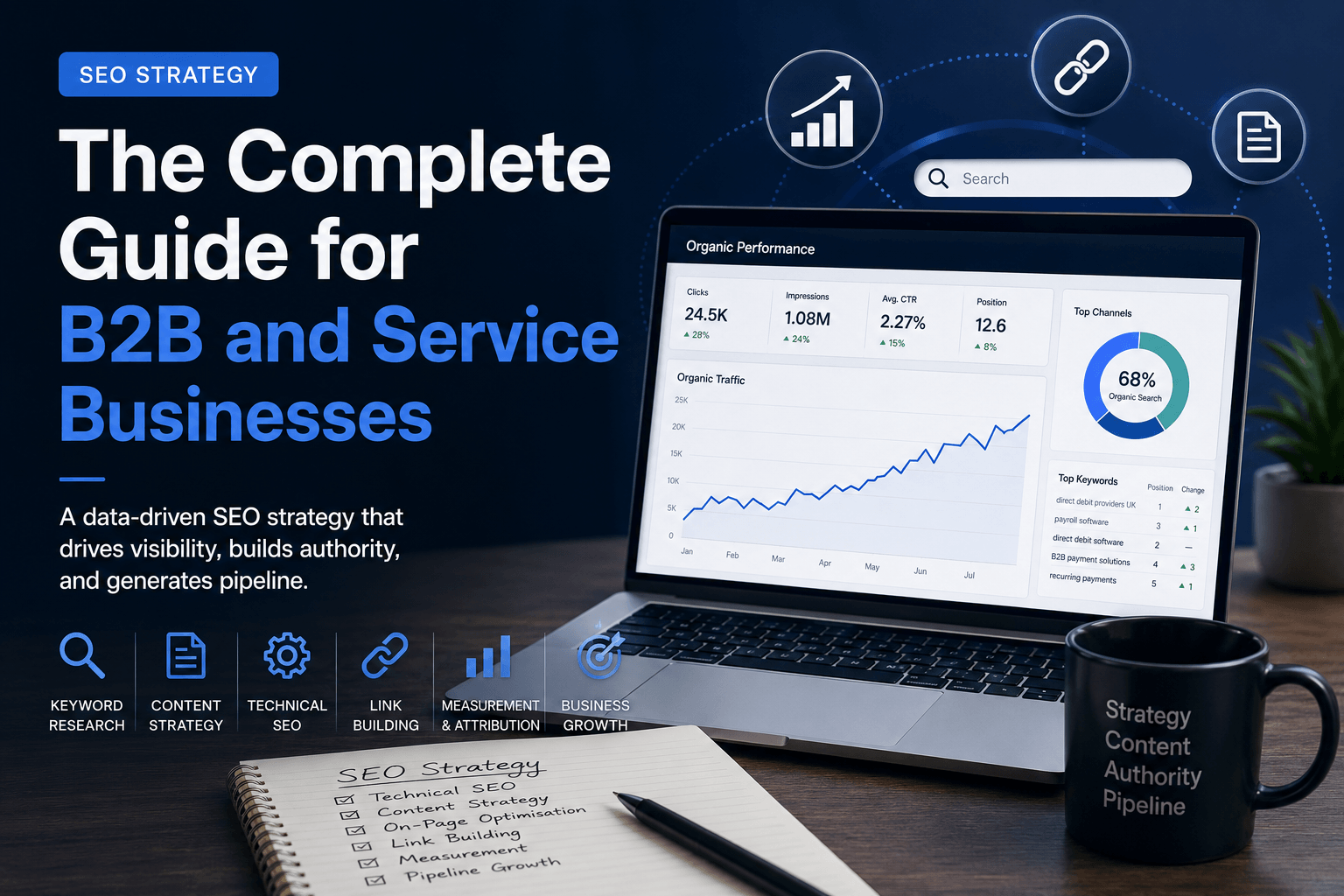
This guide covers what a real SEO strategy looks like, how to build one that works specifically for B2B and service businesses, and how to measure it in a way that connects to revenue.
Table of Contents
What Is an SEO Strategy?
An SEO strategy is a structured, long-term plan for improving a website’s visibility in organic search. It covers which keywords to target, what content to create, how to optimise the technical foundation of a site, and how to build authority through backlinks, all tied to measurable business goals.
The reason most businesses don’t actually have one is simpler than it sounds: SEO activity feels like strategy. Publishing blog posts feels like strategy. Fixing broken links feels like strategy. But without a clear decision-making framework, what to prioritise, why, and how to measure whether it’s working it’s just a collection of tasks.
The difference matters because SEO compounds. The right strategy, executed consistently, builds topical authority that grows over time. Random SEO activity doesn’t compound.
SEO strategy vs SEO tactics: what’s the difference
A tactic is a specific action: writing a blog post, fixing a slow-loading page, building a backlink. A strategy is the framework that decides which tactics to prioritise and in what order. Most businesses are rich in tactics and poor in strategy. If you can’t articulate why you’re creating a specific piece of content, which keyword it targets, which stage of the buyer journey it serves, and how it connects to a revenue goal, you don’t have a strategy yet.
Why SEO Strategy Works Differently for B2B and Service Businesses
B2B SEO and consumer SEO look similar on the surface. Both involve keywords, content and backlinks. But the underlying logic is completely different and applying consumer SEO thinking to a B2B context is one of the most common and costly mistakes I see.
In B2C, the goal is volume. High-traffic keywords drive awareness, and enough of that awareness converts to purchase. The funnel is short and often completed in a single session.
In B2B, the goal is precision. Buying cycles are long often three to twelve months. Multiple stakeholders are involved. And the person who searches ‘direct debit software for payroll’ is worth a hundred times more than someone searching ‘what is direct debit’. Volume without intent is a vanity metric.
The B2B keyword reality: low volume, high value
The most valuable keywords for B2B SEO often have fewer than 500 monthly searches. That’s counterintuitive if you’re used to thinking about SEO in terms of traffic. But in B2B, a single converted lead from a high-intent keyword can be worth tens of thousands in pipeline.
I ran SEO for Access PaySuite, a B2B payments platform. The keyword ‘best direct debit providers UK‘ has modest search volume by consumer standards. But ranking #1 for it which we achieved through a targeted content optimisation — contributed to 114 influenced pipeline opportunities according to DreamData attribution data. That’s what B2B SEO looks like when it’s working.
Why service businesses need SEO more than ads
For professional service businesses — consultancies, agencies, specialist freelancers — organic search is often more valuable than paid advertising. The reason is trust. Service buyers are making a decision that involves handing over significant budget and responsibility. They research extensively before making contact. A well-ranking, authoritative piece of content does more persuasion work than a paid ad ever can.
Paid ads stop the moment you stop paying. SEO compounds. A well-optimised page can deliver leads for years. For service businesses with tight margins, that long-term ROI is critical.

The 6 Core Components of an Effective SEO Strategy
A complete SEO strategy has six components. Miss one and the others underperform. They’re not sequential — they run in parallel, and each one reinforces the others.
1. Technical SEO foundation
Technical SEO is the unglamorous prerequisite. Before any content or link-building effort can work properly, Google needs to be able to find, crawl and understand your site. That means fast page load speeds, mobile responsiveness, clean URL structures, proper indexing and solid Core Web Vitals scores.
Technical SEO won’t make you rank on its own. But poor technical SEO will prevent everything else from working. Fix the foundation before building the house.
2. Keyword research and intent mapping
Keyword research isn’t a list of words you want to rank for. It’s a map of the questions your ideal customers are asking at different stages of the buying journey — and a decision about which of those questions you’re best placed to answer authoritatively.
For B2B, start with your ideal customer profile (ICP) before opening a keyword tool. Who are you trying to reach? What do they search for when they have the problem you solve? What do they search for when they’re actively comparing solutions? That intent mapping determines your content priorities.
3. Content strategy and topic clusters
The most effective B2B content structure is a pillar-and-cluster model. A pillar page covers a broad topic comprehensively — like this one. Supporting cluster articles go deeper on specific sub-topics and link back to the pillar. This structure signals topical authority to Google, and it creates a content experience that serves buyers at different stages of their research.
The common mistake is treating the blog as a dumping ground for anything vaguely related to your industry. Every piece of content should have a target keyword, a clear audience, and a specific role in the content architecture.
4. On-page optimisation
On-page optimisation is the craft of making individual pages as strong as possible for their target keyword. That means a clear H1 containing the primary keyword, a well-structured heading hierarchy, a compelling meta description, descriptive image alt text, and internal links that connect related content.
None of this is complicated, but it’s consistently underdone. Most B2B websites have strong content buried inside pages with weak metadata and no internal linking strategy. That’s leaving rankings on the table.
5. Authority building and backlinks
Google treats backlinks as votes of confidence. A link from an authoritative, relevant site signals that your content is trustworthy and worth ranking. For B2B, quality matters far more than quantity — one link from an industry publication is worth more than fifty directory listings.
The most sustainable link-building strategy for B2B is creating content that people naturally want to reference: original research, definitive guides, specific data points, and case studies with real results. This is slow, but it compounds. Pages ranked #1 have 3.8x more backlinks than pages ranked 2–10. (Omniscient Digital, 2025)
6. Measurement and attribution
Most SEO measurement stops at rankings and traffic. That’s the wrong place to stop — especially in B2B, where the relationship between a search click and a closed deal is rarely direct.
Effective B2B SEO measurement connects organic performance to pipeline. Tools like Google Search Console and Semrush tell you what’s ranking and how much traffic you’re getting. Revenue attribution tools like DreamData tell you which URLs are appearing in the buyer journey before deals close. That second layer of data is what transforms SEO from a marketing activity into a business case.
When I audited the Access PaySuite blog before optimising the comparison page, GSC and Semrush showed declining performance. But DreamData showed the URL was still influencing 114 pipeline opportunities despite the traffic decline. That single data point justified prioritising the optimisation above everything else on the content roadmap. That’s measurement that connects to revenue.
How to Build a B2B SEO Strategy from Scratch: A Step-by-Step Process
Here’s the process I follow when building or auditing an SEO strategy for a B2B company or service business.
Step 1: Start with your ICP, not your keywords
Before you open Semrush or Ahrefs, define exactly who you’re trying to reach. In B2B this means: which industry, which company size, which job title, and what specific problem they’re trying to solve. Your ICP determines your keyword strategy — not the other way around. If you start with keywords, you’ll end up ranking for traffic that doesn’t convert. If you start with your ICP, every keyword decision has a clear purpose.
Step 2: Audit what you already have
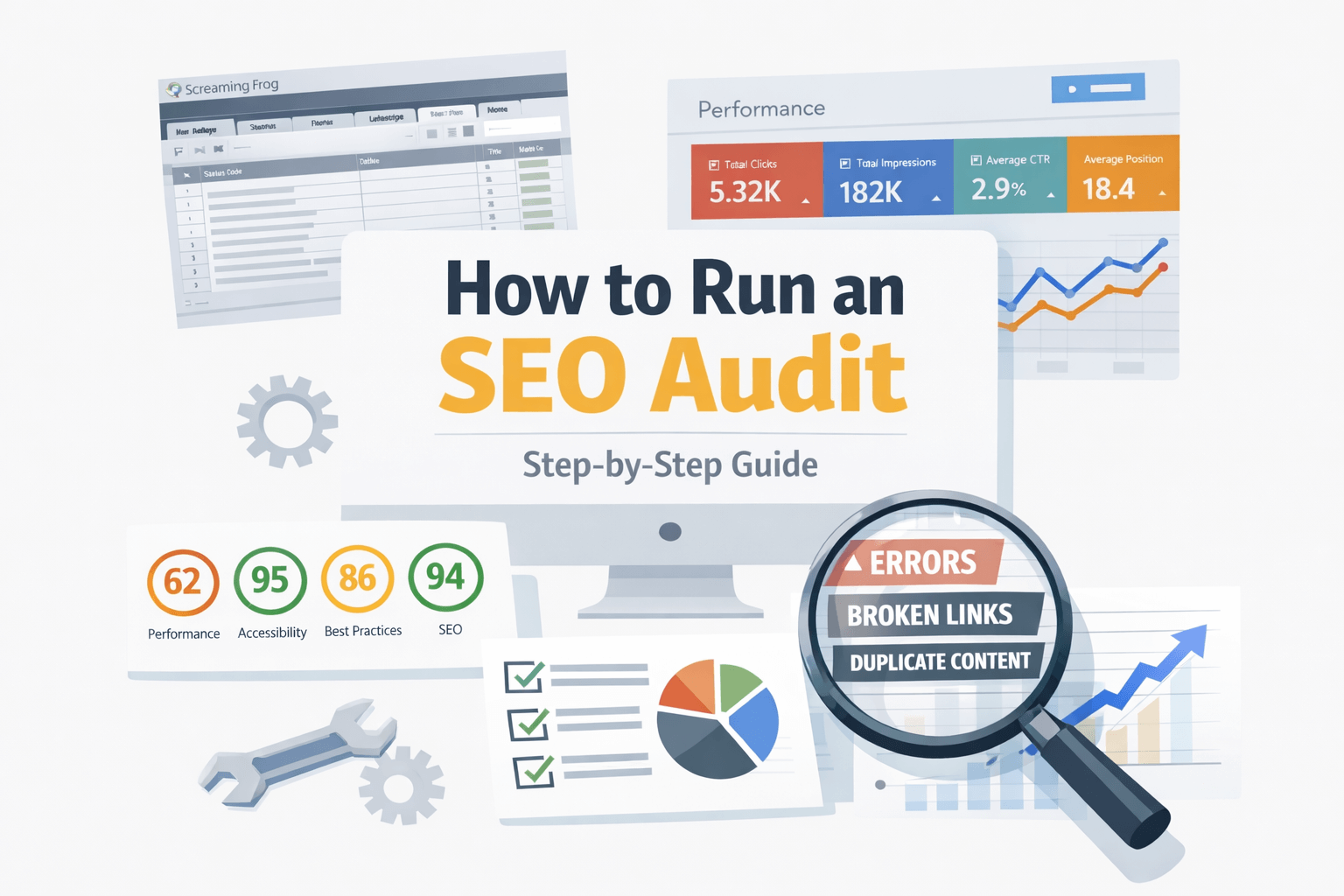
Most B2B websites have existing content that’s underperforming. Before creating anything new, run a content audit. Identify pages that have impressions but low CTR (optimise the title and meta), pages that are ranking on page 2 (optimise and build links), and pages that have zero organic performance (decide whether to improve or remove).
A technical audit should run in parallel: crawl errors, indexing issues, page speed, mobile performance, broken internal links. Fix the foundation before building on top of it.
Step 3: Map keywords to funnel stages
Group your target keywords into three buckets:
- Top of funnel (TOFU) — informational queries from people early in their research (‘what is direct debit’, ‘how does SEO work’)
- Middle of funnel (MOFU) — comparison and evaluation queries (‘best direct debit providers’, ‘SEO vs paid ads’)
- Bottom of funnel (BOFU) — high-intent queries from people close to a decision (‘direct debit software pricing’, ‘freelance SEO specialist’)
For B2B, prioritise BOFU first. These keywords have lower volume but higher conversion value. TOFU content builds awareness and authority, but BOFU content drives pipeline.
Step 4: Build your content infrastructure
With your ICP defined and keywords mapped, structure your content as pillar pages and supporting cluster articles. Each pillar page targets a broad keyword and comprehensively covers the topic. Each cluster article targets a more specific keyword and links back to the pillar. This architecture signals topical authority to Google and creates a logical content journey for your readers.
Plan your internal linking from the start. Every cluster article should link to the pillar. The pillar should link to the most relevant cluster articles. This distributes authority across the content cluster and helps Google understand the relationship between pages.
Step 5: Measure what connects to pipeline
Set up your measurement stack before content goes live, not after. At minimum: Google Search Console for keyword rankings and CTR, Semrush or Ahrefs for visibility tracking, and GA4 for on-site behaviour and conversion events. If you have a CRM and a tool like DreamData or HubSpot attribution, connect organic traffic to deal creation. That’s where SEO moves from a cost centre to a revenue driver in the boardroom conversation.
Content SEO Strategy: Where Most B2B Companies Leave Money on the Table
Content is the primary mechanism through which B2B SEO creates value. But most B2B content strategies have a fundamental flaw: they optimise for output rather than outcome. More content is not better content. More content on the wrong topics, with the wrong keyword targeting, is a significant waste of budget.
Why publishing more content is rarely the answer
The average B2B blog post gets zero backlinks and drives zero organic traffic. Not because the writing is bad, but because the topic and keyword strategy are wrong. Publishing without a clear keyword target, a defined audience, and a role in the content architecture is broadcasting into a void.
65% of top-performing B2B marketers conduct content audits at least twice a year. (Hello Operator, 2025) They’re not doing that to be thorough — they’re doing it because they’ve learned that fixing underperforming existing content consistently delivers more ROI than creating new content from scratch.
How to prioritise which content to create or optimise first
Use your keyword data and attribution data together. In Google Search Console, look for pages with high impressions but low CTR — these are ranking but not compelling enough to click. In your attribution tool, look for URLs that are appearing in pipeline journeys despite declining traffic. These are your highest-priority optimisation candidates.
The Access PaySuite case study referenced earlier is the practical version of this principle. The comparison page was declining in rankings but still active in pipeline attribution. Fixing it — repositioning the keyword target, rewriting the content, migrating the URL — produced a #1 ranking and a 23% uplift in site-wide organic visibility. That result came from smart prioritisation, not from publishing more content.
SEO Strategy in 2026: What’s Changed and What Hasn’t
SEO in 2025 looks different from SEO in 2020. AI-generated search results, zero-click searches, and the rise of tools like ChatGPT and Perplexity have changed how buyers find and evaluate information. But the fundamentals haven’t changed as much as the commentary suggests.
The rise of AI search and what it means for B2B SEO
60% of Google searches in the US ended in zero clicks in 2025, as AI Overviews answer queries directly on the results page. (Omniscient Digital, 2025) For B2B, this is less catastrophic than it sounds — zero-click searches are concentrated in informational queries, and B2B buyers conducting commercial research still click through to evaluate sources.
What has changed is the importance of being the source that AI cites. Generative Engine Optimisation (GEO) — the practice of structuring content so that AI models can extract and cite it — is now a meaningful complement to traditional SEO. That means clear definitions, direct answers to specific questions, well-structured headers, and verified statistics. The article you’re reading now is structured with those principles in mind.
For a complete guide to optimising for AI search, read the GEO strategy guide on this site.
What hasn’t changed: quality, relevance, authority
Despite everything that’s evolved, the core signal Google uses to rank content hasn’t fundamentally changed: does this page provide the best, most authoritative answer to this specific query? Quality content, relevant to a clearly defined audience, with genuine expertise behind it, still wins. The tactics shift. The underlying logic doesn’t.
E-E-A-T — Experience, Expertise, Authoritativeness and Trustworthiness — has become more explicitly important, particularly in B2B. Content written by someone with demonstrable first-hand experience in the topic outranks generic AI-generated guides. That’s both a challenge and an opportunity: if you have genuine expertise and are willing to put it into your content, you have a real edge.
SEO Strategy Best Practices: The Short Version
If you take nothing else from this guide, these are the principles that matter most:
- Start with your ICP. Define who you’re writing for before deciding what to write about.
- Fix before you build. Audit existing content and technical issues before creating new pages.
- Map keywords to intent. Know whether each piece of content serves TOFU, MOFU or BOFU.
- Use the pillar-cluster model. Build topical authority through structured content architecture with strong internal linking.
- Prioritise BOFU keywords. Low-volume, high-intent queries drive more pipeline than high-volume generic ones.
- Measure to pipeline. Connect organic performance to deal creation, not just traffic.
- Optimise for AI citation. Write in clear, structured prose with explicit definitions and verified statistics.
- Be patient. B2B SEO typically shows meaningful results at 3–6 months. The compounding returns come at 12–24 months.
Frequently Asked Questions
An SEO strategy is a plan for improving a website's visibility in organic search results. It covers keyword targeting, content creation, technical optimisation, and link building — all aligned to a business goal. Unlike ad-hoc SEO activity, a strategy connects each action to a measurable outcome, such as increased traffic, leads, or pipeline contribution.
How is B2B SEO different from B2C SEO?
B2B SEO targets decision-makers with specific, high-intent needs rather than broad consumer audiences. Keywords tend to have lower search volumes but much higher commercial value. Buying cycles are longer and involve multiple stakeholders, so content needs to educate and build trust across several funnel stages — not just drive a single click.
Most B2B SEO strategies begin showing measurable movement in rankings within 3–6 months. Significant traffic and pipeline impact typically takes 6–12 months. The timeline depends on domain authority, competition, content quality and technical health. SEO compounds over time — the returns grow the longer the strategy is maintained.
A complete B2B SEO strategy should cover: technical SEO foundations, keyword research mapped to buyer intent, a content strategy built around pillar pages and topic clusters, on-page optimisation, authority building through backlinks, and measurement that connects organic performance to pipeline and revenue — not just traffic.
Yes. Service businesses typically compete for lower-volume, high-intent keywords where buyers are close to a decision. The content strategy should prioritise comparison pages, case studies and service-specific landing pages over broad informational content. Local SEO may also be relevant depending on whether the business serves a specific geography.
Start with Google Search Console for keyword rankings and click data, and Semrush or Ahrefs for domain visibility. Then connect organic traffic to CRM data using a revenue attribution tool like DreamData or HubSpot. This lets you see which organic URLs appear in the buyer journey before deals close — moving SEO measurement from impressions to pipeline contribution.
Get a personalised audit and a clear action plan to improve your rankings, organic traffic and pipeline.